Our Role in Archaeology
The MCFN Archaeology Unit participates in archaeological projects occurring throughout our treaty territory and provides guidance to ensure cultural heritage is respected.
The Archaeology Unit’s work includes:
- Reviewing archaeological assessments and technical reports
- Participating in archaeological fieldwork
- Monitoring archaeological excavations
- Protecting archaeological sites and cultural materials
- Supporting the respectful treatment of burial sites and ancestral remains
- Providing cultural guidance to archaeologists, consultants, and developers
- Working with government agencies on heritage policy and legislation
- Supporting the protection and repatriation of cultural belongings
Through this work, MCFN helps ensure that archaeological investigations properly recognize and respect Indigenous history and heritage.
Field Liaison Representative Program
A key component of the MCFN Archaeology Unit is the Field Liaison Representative (FLR) program.
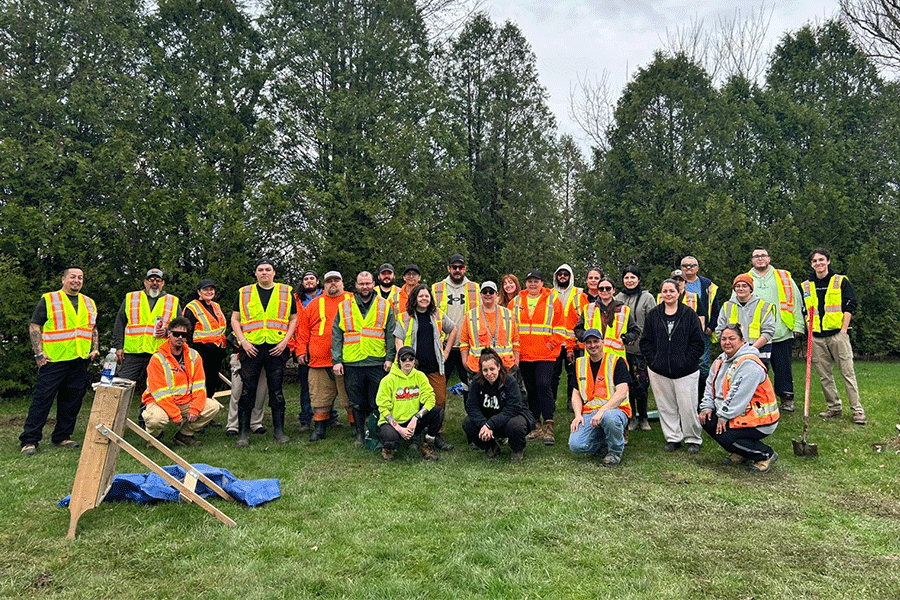
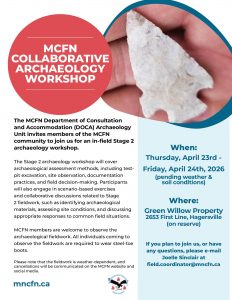
FLRs are trained MCFN community members who participate directly in archaeological fieldwork across the Nation’s treaty territory. They work alongside licensed archaeologists during archaeological assessments to help ensure that Indigenous perspectives and cultural protocols are respected.
Field Liaison Representatives assist with:
- Monitoring archaeological excavations
- Observing archaeological methods and documentation
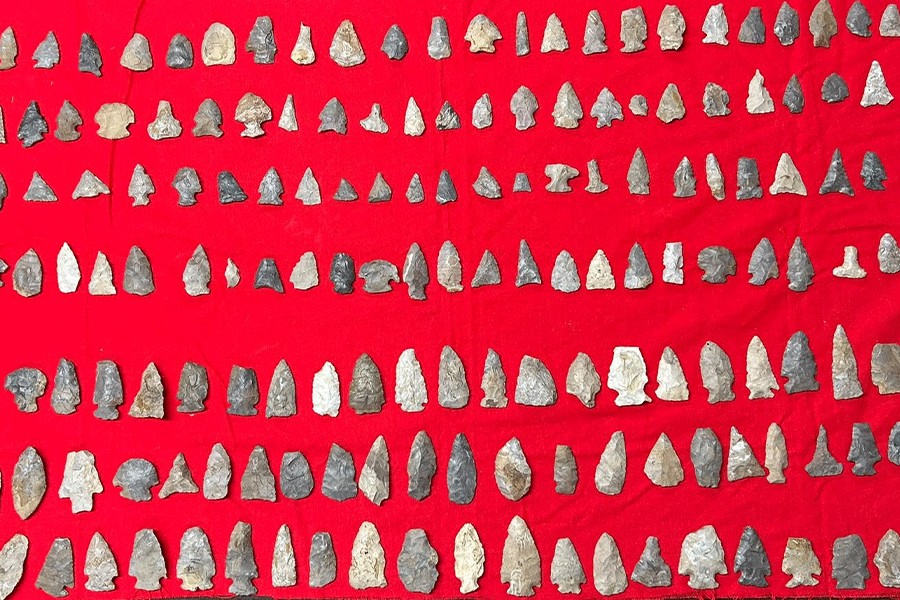
- Identifying artifacts and cultural materials
- Ensuring respectful treatment of archaeological sites
- Providing communication between archaeologists and the Nation
The FLR program provides meaningful employment opportunities for community members while strengthening MCFN’s role in protecting and stewarding our cultural heritage.
Protecting Burial Sites and Ancestors
The protection of burial sites and ancestral remains is a priority for the Mississaugas of the Credit First Nation. When burial sites or human remains are encountered during development or archaeological investigations, MCFN works with archaeologists, government agencies, and project proponents to ensure that our ancestors are treated with dignity and respect.
These situations require careful coordination and culturally appropriate decision-making. MCFN works to ensure that any actions taken reflect community values and respect the cultural and spiritual significance of ancestral resting places.
Click here for the MCFN Burial Site Protocol
Archaeology in MCFN Treaty Territory
The Mississaugas of the Credit First Nation has treaty rights and responsibilities across approximately 3.9 million acres of treaty territory in southern Ontario.
This territory includes areas throughout the Greater Toronto Area and surrounding regions, including lands within Hamilton, Halton, Peel, York, Niagara, Brant, Waterloo, and other neighbouring municipalities.
Thousands of archaeological sites have been identified throughout this territory. These sites represent generations of Indigenous occupation, travel, trade, and community life.
MCFN works to ensure that these places are properly identified, studied, and protected when development projects occur within our treaty lands.
Working with the Mississaugas of the Credit First Nation
Archaeologists, consultants, municipalities, and developers working within MCFN treaty territory may be required to engage with the Mississaugas of the Credit First Nation regarding archaeological assessments.
MCFN may participate in a variety of archaeological activities, including:
- Stage 1–2: Archaeological Assessments
- Stage 3: Site Evaluations
- Stage 4: Excavations
- Burial Site Investigations
- Archaeological report review and technical guidance
MCFN participation helps ensure that archaeological investigations respect Indigenous cultural heritage and reflect the interests of the Mississaugas of the Credit First Nation.
Supporting Community Knowledge and Participation
Archaeology provides an opportunity to reconnect with the deep history of our people and our lands.
Through the Archaeology Unit, MCFN supports opportunities for community members to participate in archaeological fieldwork, training, and cultural learning activities.
These initiatives help strengthen community knowledge, provide employment and training opportunities, and support the ongoing protection of the Nation’s heritage for future generations.
DOCA Mandate
To engage in consultation processes with the Crown (Federal and Provincial governments) and private sector proponents on actions and proposed development projects that may impact the rights and interests of MCFN and to ensure that environmentally sustainable practices are being implemented in response to any concerns about the land, water, air, species at risk, and the health of its people.
DOCA will assess and help mitigate impacts on our rights, land claims, and ways of life by building relationships/partnerships with governments and private sector proponents. The department also works to advance negotiations with key proponents for securing long term relationship agreements or business partnerships in the spirit of peace, respect, and friendship.
DOCA will ensure that responsible practices are implemented to protect the environment, and the cultural heritage and archaeology of the First Nation. DOCA is responsible for strengthening recognition of the rich heritage of MCFN by increasing public awareness and by being directly involved in all planning and development within MCFN’s traditional and treaty territory.